
A lot of candidates prepare for interviews in a very generic way.
They search:
-
common HR questions
-
top interview questions
-
how to answer tell me about yourself
-
interview tips for freshers
-
how to introduce yourself in interview
-
interview confidence tips
Then they memorize a few answers, watch a few videos, maybe practice once or twice, and hope that will be enough.
Sometimes that helps a little.
But very often, it does not help enough.
Why?
Because most interviews are not actually testing whether you know “interview questions” in a generic sense.
They are testing whether you make sense for this role.
That is the key shift many candidates miss.
A marketing interview is not the same as a data interview.
A data interview is not the same as an HR interview.
An operations interview is not the same as a sales interview.
A software interview is not the same as a content interview.
An internship interview is not the same as an experienced-role interview.
Even when the same question appears, the expected answer changes based on the role.
That is why generic interview prep often creates generic interview performance.
And generic interview performance usually feels weak.
Not always because the candidate is weak.
But because the preparation was not role-aware enough.
That is exactly why role-based interview preparation matters so much.
If you want better interview results, you need to stop preparing like this:
“What are the common interview questions?”
and start preparing like this:
“What is this role likely to test, and what proof do I need to sound ready for it?”
That one shift changes everything.
It changes:
-
how you read the JD
-
how you prepare your self-introduction
-
how you choose project examples
-
how you explain strengths
-
how you answer role-specific questions
-
how you sound in the room
-
how believable your fit feels
And that fits directly with GyanBatua’s broader positioning around role-fit clarity, interview readiness, mock interviews, and job-aware AI guidance.
In this guide, we will break down:
-
why role-based interview prep works better than generic prep
-
what different roles are actually evaluating
-
how to use the JD to prepare smarter
-
how freshers should prepare without over-apologizing for low experience
-
how to practice answers naturally
-
how to identify what the interviewer is really trying to confirm
-
what interview readiness should actually look like before your next interview
Why generic interview prep usually underperforms
A lot of candidates think interview preparation means:
-
writing down answers
-
memorizing an introduction
-
learning strengths and weaknesses
-
watching “top 20 interview questions” videos
-
practicing one or two HR answers
This is not completely useless.
But it is incomplete.
Because interviews are not mainly checking whether you have rehearsed nice lines.
They are usually checking:
-
role fit
-
practical understanding
-
proof depth
-
clarity
-
communication maturity
-
problem-solving style
-
seriousness about the role
-
how believable your readiness feels
And those things change from role to role.
For example:
A data role may evaluate:
-
structured thinking
-
tools
-
analysis depth
-
project clarity
-
logic
-
comfort with numbers
A marketing role may evaluate:
-
campaign understanding
-
content awareness
-
audience thinking
-
examples
-
initiative
-
ability to think in channels and outcomes
An HR role may evaluate:
-
people-process understanding
-
communication maturity
-
coordination ability
-
seriousness
-
professionalism
A sales role may evaluate:
-
confidence
-
persuasion
-
energy
-
customer orientation
-
resilience
-
follow-up instinct
A software role may evaluate:
-
fundamentals
-
problem-solving
-
debugging logic
-
technical honesty
-
project depth
This is why generic preparation often breaks.
The candidate may have prepared “questions,” but not prepared relevance.
And interviews reward relevance more than rehearsed completeness.
What role-based interview preparation actually means
Role-based interview preparation does not mean memorizing 100 role-specific answers.
It means understanding five things clearly:
1. What the role is actually for
What kind of work is this person being hired to do?
2. What the interviewer is likely trying to confirm
What makes them believe someone is ready for this job?
3. What proof you already have
Which projects, internships, assignments, tools, situations, or experiences support your case?
4. What kind of questions are likely
Is the interview likely to focus on:
-
technical depth
-
project explanation
-
communication
-
execution
-
ownership
-
people coordination
-
learning ability
-
pressure handling
-
role motivation
5. What kind of language the role expects
An analyst should not sound like a generic motivational speaker.
A sales candidate should not sound flat and purely theoretical.
A fresher should not try to sound falsely senior.
A career switcher should not sound confused about the shift.
That is what role-based interview preparation actually means.
It means preparing in the logic of the role.
The biggest interview-prep mistake candidates make
Many candidates prepare answers.
Very few prepare role-fit.
That is the real difference.
For example, a candidate may prepare a polished “Tell me about yourself” answer.
But if that answer does not help the interviewer understand:
-
what role the candidate fits
-
what proof supports that
-
what direction they have
-
why they make sense for this opening
then the answer still feels weak.
The candidate may sound fluent.
But not convincing.
This is one of the most important ideas in interview performance:
An answer is not strong just because it is smooth.
It is strong when it helps the interviewer feel:
-
this person makes sense for this role
-
this person understands what they are applying for
-
this person has evidence, not only enthusiasm
-
this person sounds realistic and useful
That is why role-based prep beats generic prep.
Start interview preparation with the JD, not random questions
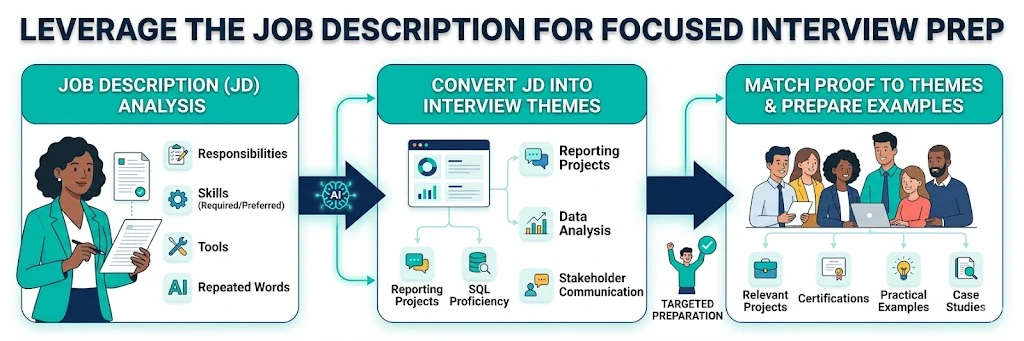
The job description is one of the best interview-prep documents you already have.
But many candidates use it only once — just to decide whether to apply.
That is a missed opportunity.
Because the JD usually tells you:
-
what responsibilities matter
-
what tools matter
-
what the company values
-
what questions are likely to come up
-
what kind of proof you should prepare
If you prepare for an interview without using the JD properly, you are often preparing too broadly.
A stronger approach looks like this:
Step 1: Read the JD carefully
Highlight:
-
responsibilities
-
required skills
-
preferred skills
-
tools
-
repeated words
-
outcome language
Step 2: Convert the JD into interview themes
If the JD mentions:
-
dashboards
-
reporting
-
SQL
-
analysis
-
stakeholder communication
then likely interview themes include:
-
explain a reporting project
-
how did you use SQL?
-
what kind of data cleaning or analysis have you done?
-
how did you communicate findings?
-
what decisions did your analysis support?
Step 3: Match your proof to those themes
Now identify:
-
projects
-
internships
-
college work
-
certifications with output
-
practical examples
-
case studies
that support those role themes
This is much smarter than preparing random generic answers.
How interview expectations change by role
Different roles produce different interview expectations.
That sounds obvious, but candidates still underestimate how much it matters.
Marketing interview preparation
For marketing roles, interviewers often want to see:
-
understanding of campaigns
-
channel awareness
-
audience thinking
-
content instinct
-
analytical curiosity
-
examples of execution
-
awareness of results or metrics
They may ask:
-
tell me about a campaign or content project you worked on
-
how would you think about increasing engagement?
-
what metrics matter in digital campaigns?
-
how do you understand audience behavior?
-
why marketing?
A weak marketing answer sounds too generic or too theoretical.
A stronger one shows:
-
examples
-
channel awareness
-
audience or content logic
-
performance curiosity
Data or analyst interview preparation
For analyst roles, interviewers usually want:
-
structured thinking
-
tool clarity
-
data comfort
-
dashboard or reporting exposure
-
business interpretation
-
project depth
They may ask:
-
explain your data project
-
what tools did you use?
-
how did you clean the data?
-
what insights did you derive?
-
how do you approach trends or anomalies?
-
what does this metric mean?
Weak answers sound like textbook definitions.
Strong answers sound:
-
structured
-
tool-aware
-
example-backed
-
clear about process
HR interview preparation
For HR roles, interviewers often look for:
-
communication maturity
-
people-process understanding
-
professionalism
-
coordination ability
-
seriousness about HR as a function
They may ask:
-
why HR?
-
what do you understand about recruitment or HR operations?
-
tell me about a time you coordinated something
-
how would you handle communication with candidates?
-
what interested you in people-focused work?
Strong HR answers usually feel:
-
grounded
-
people-aware
-
process-aware
-
professional
Sales interview preparation
Sales interviews often look for:
-
confidence
-
clarity
-
energy
-
persuasion
-
initiative
-
handling discomfort or rejection
-
activity orientation
They may ask:
-
why sales?
-
tell me about a time you convinced someone
-
how do you handle rejection?
-
what makes you comfortable with targets?
-
how would you approach a new prospect?
Strong sales answers usually feel:
-
direct
-
energetic
-
believable
-
action-oriented
Operations interview preparation
Operations roles often test:
-
ownership
-
reliability
-
execution
-
process comfort
-
coordination
-
problem handling
Interviewers may ask:
-
how do you manage deadlines?
-
tell me about a time you handled coordination
-
how do you approach process issues?
-
how do you stay organized?
Strong answers sound:
-
practical
-
dependable
-
execution-oriented
-
calm under pressure
Software interview preparation
Software roles usually go deeper into:
-
concepts
-
coding
-
logic
-
debugging
-
project depth
-
fundamentals
-
honesty around technical exposure
They may ask:
-
explain your project architecture
-
why did you use that stack?
-
how would you solve X problem?
-
what were the bugs you faced?
-
what trade-offs did you consider?
Strong software answers show:
-
technical clarity
-
honesty
-
structured problem-solving
-
real ownership of the project
Why freshers often struggle with interview preparation
Freshers often carry the wrong mental model into interviews.
They think:
-
I don’t have enough experience
-
I need to sound very impressive
-
I should hide that I’m a fresher
-
I should memorize polished answers
-
I should make my projects sound much bigger
That creates awkward interview performance.
Because recruiters already know you are a fresher.
They are not expecting:
-
years of experience
-
advanced industry judgment
-
senior-level ownership
They are usually expecting:
-
role awareness
-
useful project or internship proof
-
communication clarity
-
seriousness
-
learning ability
-
coachability
-
enough skill basics to justify the next step
So the goal for freshers is not:
sound senior
It is:
sound prepared, role-aware, and believable
That is a much more realistic and much more effective target.
What strong role-based interview preparation should include
A strong prep plan usually includes:
1. A role-specific self-introduction
Your introduction should help the interviewer place you quickly.
2. A proof bank
Prepare 5-7 proof examples from:
-
projects
-
internships
-
assignments
-
campus work
-
volunteer work
-
freelance tasks
-
technical or practical examples
3. Basic role knowledge
You do not need infinite theory.
But you do need role basics.
4. Question categories
Prepare for:
-
tell me about yourself
-
why this role
-
why this company
-
strengths and weaknesses
-
project questions
-
problem-solving or case questions
-
behavioral questions
-
skill-based questions
-
challenge / learning questions
5. Mock speaking practice
You need oral preparation, not only written preparation.
6. Role-specific weak spot review
Ask:
-
what topic feels shaky?
-
what project do I explain poorly?
-
where do I ramble?
-
where do I sound generic?
That is how interview readiness actually improves.
The role of proof in interview success
Many candidates talk too generally in interviews.
They say things like:
-
I am hardworking
-
I learn fast
-
I worked on marketing
-
I did a data project
-
I was part of the hiring process
-
I handled team coordination
This sounds okay at first.
But it is weak because it does not show proof.
Proof makes answers believable.
For example:
Weak
I worked on marketing.
Better
During my internship, I supported content planning and campaign execution for social media and tracked engagement performance weekly.
Weak
I know data analysis.
Better
In one of my projects, I used Excel and Power BI to clean data, identify category-level trends, and present the results through dashboards.
Weak
I have HR exposure.
Better
I supported sourcing coordination, candidate communication, and interview scheduling during an internship project related to hiring support.
That difference matters a lot.
Because interviews are not just about saying you know something.
They are about helping someone trust that your claim is connected to real work.
A practical framework for role-based interview preparation
Use this before any important interview.
Role-Based Interview Prep Framework
1. Read the JD like a recruiter
Extract:
-
responsibilities
-
tools
-
key skills
-
outcome signals
2. Ask: what is the interviewer likely trying to confirm?
For example:
-
can this person actually do the work?
-
does this fresher understand the field?
-
can this candidate explain their project honestly?
-
is this person trainable and role-aware?
3. Build a proof bank
Prepare 5-7 role-relevant examples.
4. Rewrite your introduction for the role
Make it easier to place you quickly.
5. Practice likely question families
Do not practice random questions. Practice high-probability themes.
6. Speak out loud
You need speaking fluency, not only mental readiness.
7. Improve the weak parts
Identify the 2-3 areas where your answers still feel weak.
8. Prepare thoughtful questions to ask the interviewer
Good candidates also sound good at the end.
This process creates much better interview readiness than generic prep.
What role-based interview prep improves
When you prepare this way, you usually improve:
-
answer relevance
-
clarity
-
role-fit visibility
-
project explanation
-
confidence
-
less rambling
-
interviewer trust
-
stronger self-introduction
-
better handling of follow-up questions
This is exactly why role-based preparation converts better.
Because the interviewer stops hearing:
“a generic candidate with interview answers”
and starts hearing:
“a candidate who makes sense for this role”
That is the real win.
Conclusion
Interview preparation is not about sounding good in general.
It is about sounding ready for the role in front of you.
That is the difference between:
-
random preparation and strategic preparation
-
generic answers and believable answers
-
memorization and relevance
-
nervous talking and role-fit communication
So before your next interview, do not only ask:
“What are the top interview questions?”
Ask a smarter question first:
What does this role need me to sound ready for?
That is where stronger interview performance begins.
Get My Role-Based Interview Prep
FAQ
What is role-based interview preparation?
It means preparing based on the exact role, expected skills, JD themes, and likely proof areas instead of using only generic interview questions.
Why is generic interview prep not enough?
Because different roles test different things. A data role, marketing role, and HR role do not expect the same kind of answers, examples, or language.
Should freshers also prepare role-by-role?
Yes. Freshers especially need role-based prep because they rely heavily on projects, internships, and coursework to prove fit.
What should I prepare first before an interview?
Start with the job description, then identify what the interviewer is likely evaluating, and prepare relevant examples and question themes around that.
How many interview answers should I prepare?
You do not need hundreds of memorized answers. You need a good self-introduction, a strong proof bank, and practice around the main question categories.
About the Author

Md Ashik Alam
Ready to orchestrate your AI future?
Converiqo.AI helps you design, deploy, and scale automation workflows that move your business faster. Connect with our team to see the platform in action and co-create the next chapter of intelligent operations.
Read More Blogs
Discover more insights and product updates curated by the Converiqo.AI team.

Learn how conversational customer self-service helps customers get faster answers, complete support tasks, and reduce the need for agent-led resolution.
Learn how conversational customer self-service helps customers get faster answers, complete support tasks, and reduce the need for agent-led resolution.
Why Customer Service Feels Slow: 9 Bottlenecks Customer Self-Service Can Fix
Discover 9 support bottlenecks that slow customer service down and learn how customer self-service automation improves speed, consistency, and resolution.

Why Support Teams Need Knowledge-Grounded Self-Service, Not Just FAQ Bots
Learn why support teams need knowledge-grounded self-service, not just FAQ bots, to improve answer quality, workflow completion, and support resolution.